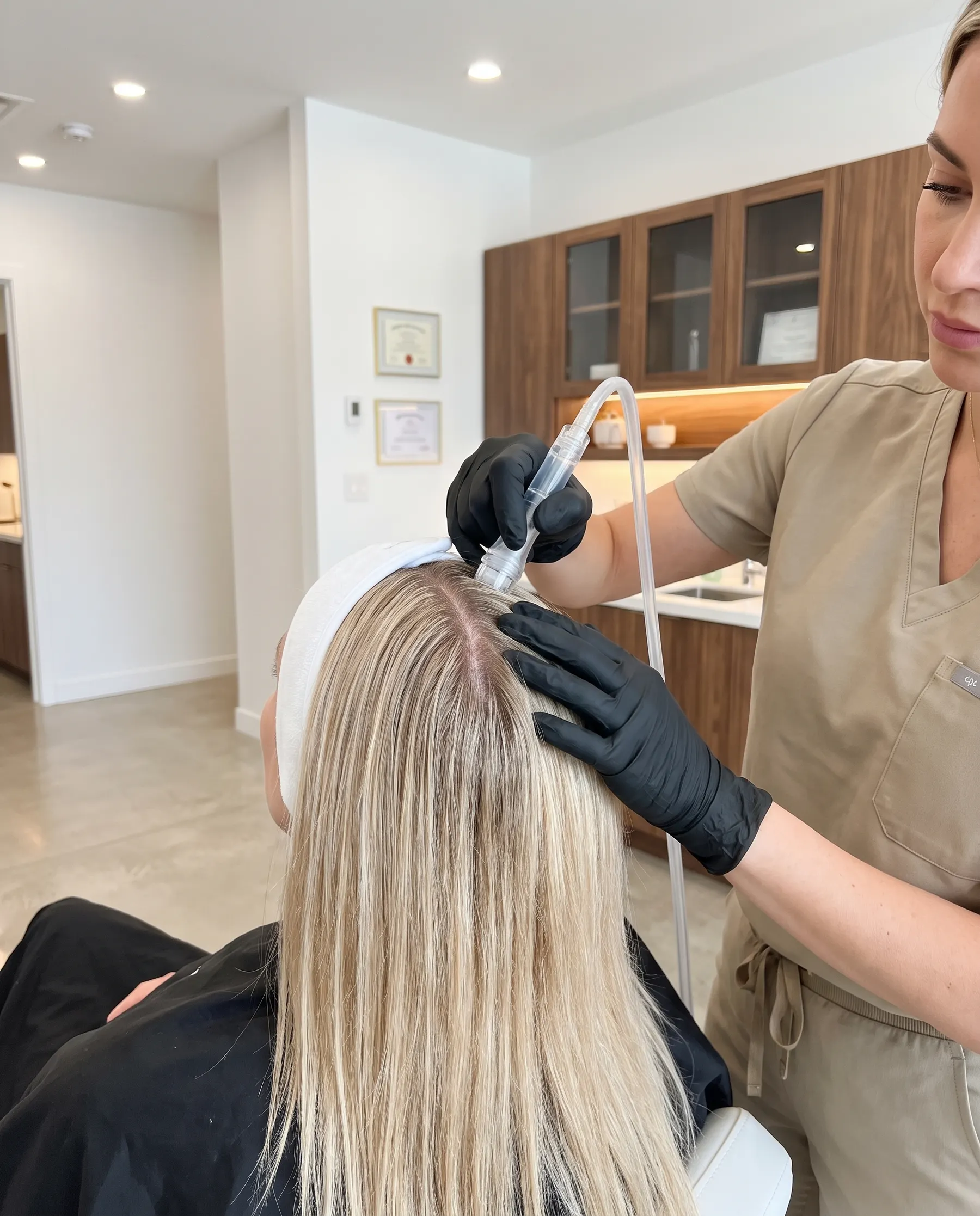
A widening part, a thinner ponytail, hair in the sink every morning. We help you understand what is happening, and we point you in the right direction.
Every follicle cycles through growth, rest and shedding on its own schedule, so losing some every day is normal. The rest can come from more than one thing: two very common patterns already give useful clues, without being enough to name a cause.
Too many hairs switch over at once
After childbirth, surgery, a fever, marked weight loss or a significant stress, diffuse shedding can show up a few months later.
Follicles produce finer hair
Nothing falls suddenly; the hair thins on top of the head and along the part, and heredity and hormones can both be part of it.
The scalp is the ground
A congested, irritated or tight scalp does not cause the loss, but it is the only part of the equation an institute can act on.
It depends which kind, and how it started already tells you a lot.
Shedding that worries you deserves a doctor before anything else, and we will say so in consultation rather than after a series of treatments.
What we can treat here
The condition of the scalp
Residue, itching, tightness, or hair that turns oily within a day. This is the skin your hair grows from, and it can be deep-cleaned.
The habits around the shedding
Disrupted sleep, an unbalanced diet, a long stretch of stress. That can be supported; it cannot be cured.
What we do not treat here
Diagnosing the cause
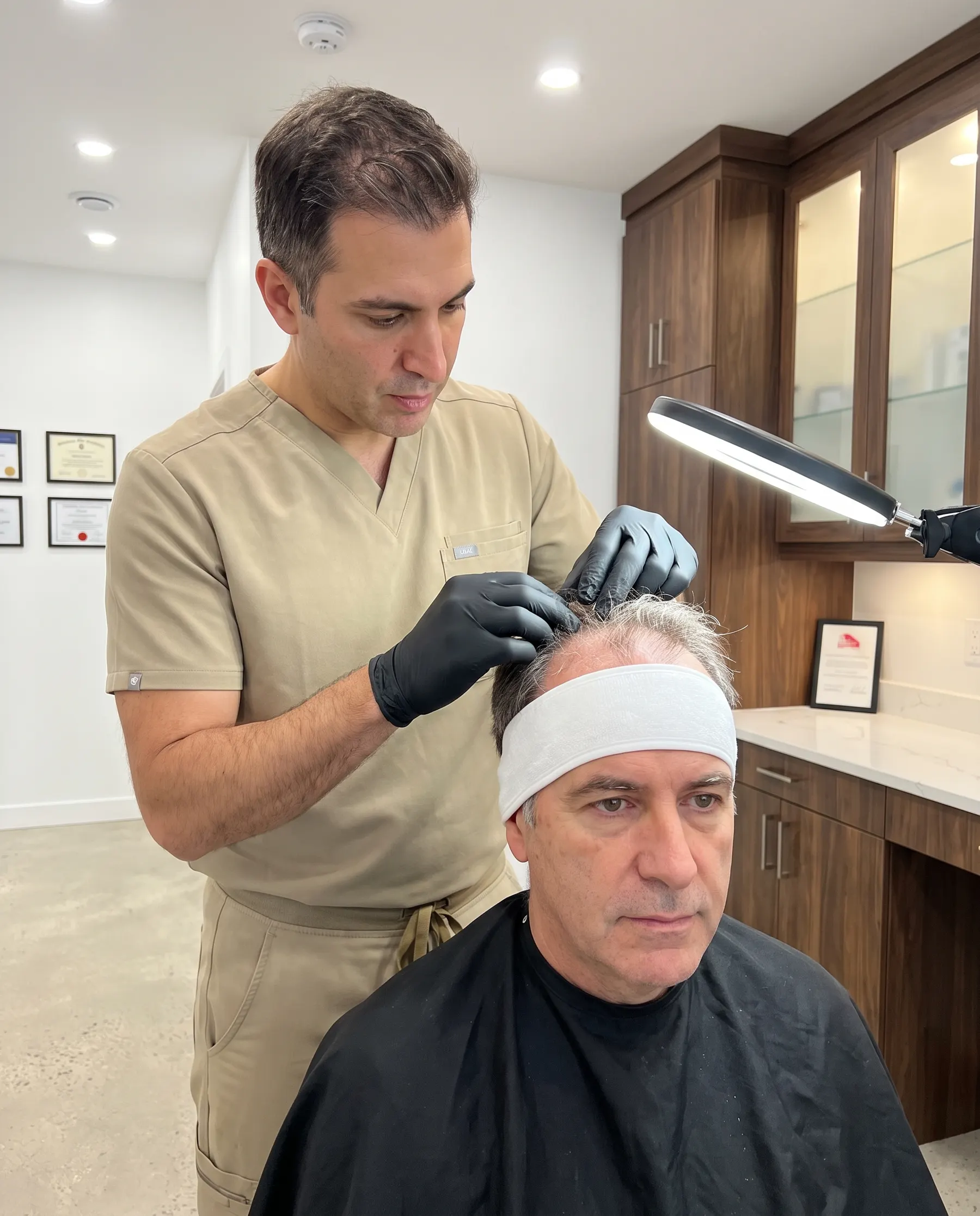
The institute diagnoses no form of hair loss and prescribes nothing. A doctor, ideally a dermatologist, starts from your history and an examination of the scalp, and orders blood work when the context calls for it. One person can have two causes at the same time.
Sudden shedding, or signs that leave no doubt
Loss that started abruptly, a round bare patch, skin that looks smooth and shiny where the hair has gone, redness, crusting, pain or a burning scalp: that goes to a doctor without delay. Some kinds of loss become permanent if you wait.
Loss where your hairstyles pull
A tight ponytail, braids, extensions or a very tight bun, worn for a long time, can damage the follicles along the hairline and the temples. Loosening early often helps, and it is the one step on this page that costs nothing.
Regrowth
We present none of our scalp treatments as a regrowth treatment, and the institute's team neither diagnoses nor treats shedding. Established or progressive loss calls for a medical assessment: the physician who practises on the premises may, after his own work-up, propose certain medical treatments such as PRP for hair when they are appropriate. Esthetic scalp treatments such as Keravive remain separate and are not regrowth treatments.
Established hereditary hair loss
A treatment applied at the surface does not restart a follicle that has stopped producing. Managing it is medical, and some treatments started early enough can slow it down.
How we support hair loss
Targeted treatments on the ground and on habits, alongside what a doctor does.
The consultation is free, and it is there to look at the state of your scalp and see whether an esthetic treatment makes sense. It is not there to find the cause of shedding: if your density has genuinely dropped, we point you to a doctor first.
Beautiful Spa that is a one stop shop for all your beauty, body and aesthetic needs. The staff is skilled, warm and inviting and the zen decor makes you want to never leave. I have loved all of my services thus far, and I will continue to come back to discover new services.
Everything people ask us before a first session, answered plainly.
How much hair a day is normal to lose?
Somewhere between fifty and a hundred, and that figure almost always surprises people who discover it. Every follicle runs its own cycle, so a share of them sheds naturally each day. Counting does not get you far anyway. What should get your attention is a change from your own normal: a noticeably larger amount, a widening part, a ponytail that has lost thickness. To follow it at home, a photo helps. Take the part and the top of your head in the same light, at the same angle and with the same hairstyle, and do it again two or three months later. Memory is a poor witness on this subject.
Does stress really make hair fall out?
In some people, yes, and the delay explains why so many miss the connection. A significant physical or emotional shock can push a lot of hairs into the shedding phase at the same time. The shedding often shows up a few months later, once the hard stretch has passed. By the time it arrives the person is often doing better, and they look for the cause in the wrong place. When that is genuinely what happened and the trigger is gone, the shedding often improves on its own. If it persists or stays heavy, do not settle for « it is just stress »: the doctor starts from your history and the examination, and orders blood work based on what he sees.
Do scalp treatments make hair grow back?
No, and we would rather put that in writing. A scalp treatment cleans, unblocks and soothes the skin; it does not restart a follicle that has stopped producing. What it does still has value: a healthy scalp is better ground, and the discomfort that often comes with shedding eases. If somewhere promises regrowth from a surface treatment, the promise does not hold. That is the kind of spending better saved for a medical appointment.
Should I see a doctor before coming here?
In most cases, yes, and it is probably the most useful advice on this page. Established or rapid shedding can have a cause, sometimes more than one, and it starts with your history and an examination of the scalp. Some contributing factors, such as an iron deficiency or a thyroid problem, can be looked for and managed when they are there. Other kinds of loss call instead for a treatment that slows them down. Either way, no treatment in an institute replaces that assessment. We can work alongside it, on the ground and on habits. We cannot work instead of it.
Is it the same for women and men?
It often shows differently, without that being a rule. In men the temples and the crown are frequently affected. In women a widening part and a drop in density on top are common. Those patterns give clues, they do not identify the kind of loss. And the nuance matters, because a woman comparing her situation to a man's often wrongly concludes that hers is something else entirely. Men will find their areas and durations on the section built for them.
Does PRP work?
The physician answers that question, not us, and he will do so after examining you. What he alone can determine is whether your kind of loss is one of the situations where this treatment makes sense. What we can say is that PRP is a physician's procedure carried out here, that it has its own consultation and its own file, and that it does not suit every situation.
Ready to meet the best version of yourself?
Send us your questions and we will guide you toward the treatments that suit you best.