Why do you need to know your skin type?
Your skin type sets what your skin tolerates, and therefore what will help it or throw it off balance.
Oily skin treated as dry skin turns shiny and congested. Dry skin treated as oily skin tightens and flakes. The same product, on two different skins, gives two opposite results.
It also explains why a product a friend swears by does nothing for you. It was not speaking to your skin.
The thirty-minute test, at home
Step 1. Cleanse your face
With a gentle cleanser, then pat it dry rather than rubbing.
Step 2. Apply nothing
No cream, no serum, no makeup. Wait at least thirty minutes, an hour if you can: that is how long your skin needs to go back to its usual behaviour.
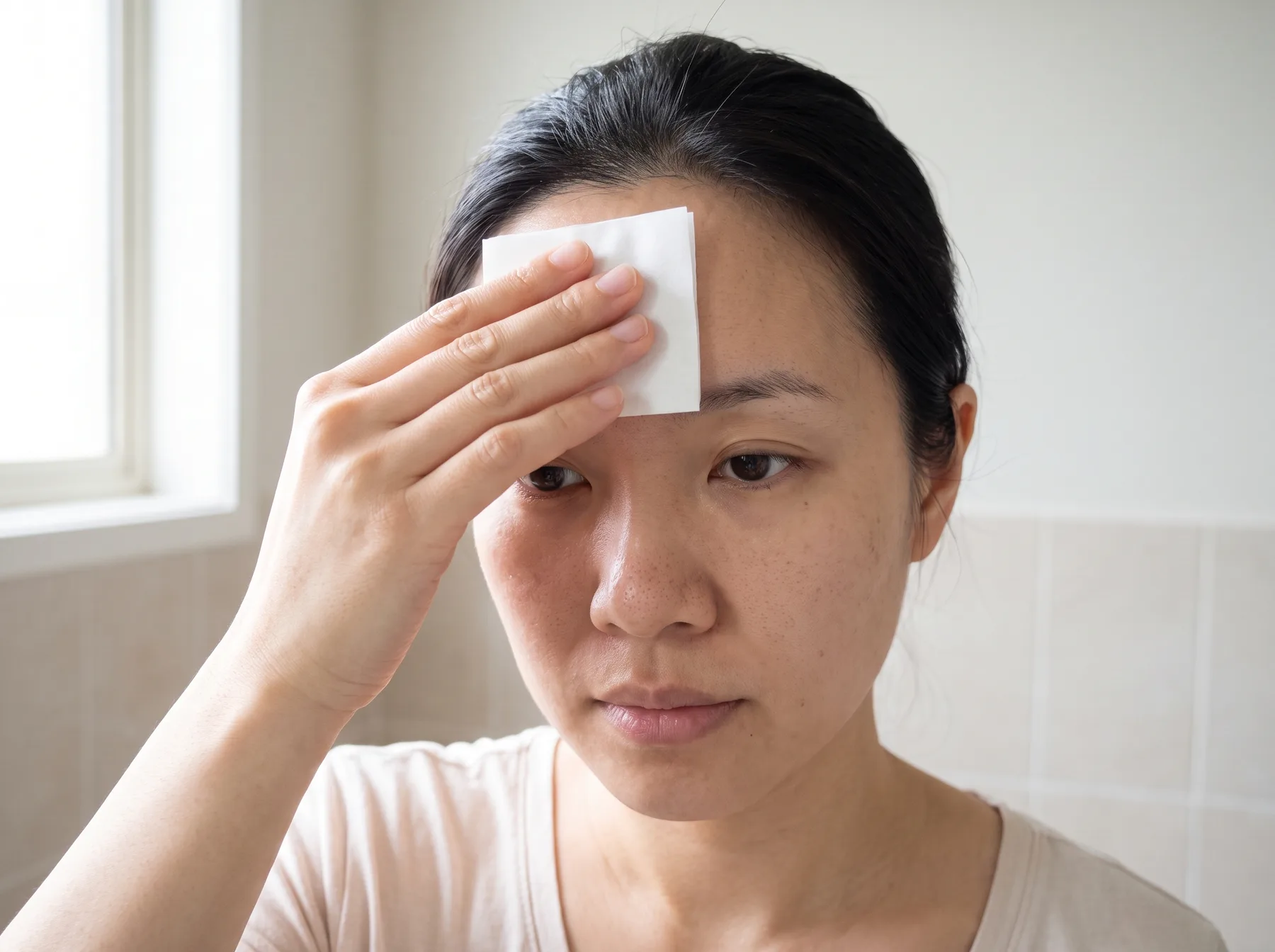
Step 3. Press a sheet of blotting paper
Lightly, on different areas of your face, the forehead, the cheeks, the nose and the chin. Look at what it picked up.
- No trace of oil: dry or normal skin.
- Traces on the T-zone only, meaning forehead, nose and chin: combination skin.
- Traces across the whole face: oily skin.
Step 4. Listen to the feel
Skin that tightens or itches leans dry. Skin that feels comfortable, neither shiny nor tight, is normal. Shine that comes back during the day leans oily.
Step 5. Look closely
Visible pores and frequent breakouts go with oily skin. Flaking and rough patches go with dry skin.
The four skin types, and what each one asks for

Normal skin
Comfortable and supple, neither shiny nor tight. The blotting paper picks up almost nothing. What it mostly asks for is to be left alone: a gentle cleanser, light hydration, sun protection.
Dry skin
It tightens, it itches, it shows rough patches and sometimes flaking. The paper stays clean. It asks for richer textures and a cleanser that does not strip.

Combination skin
The T-zone shines while the cheeks stay normal or dry. The paper picks up on the forehead, nose and chin, and nowhere else. It asks for two different gestures on one face.
Oily skin
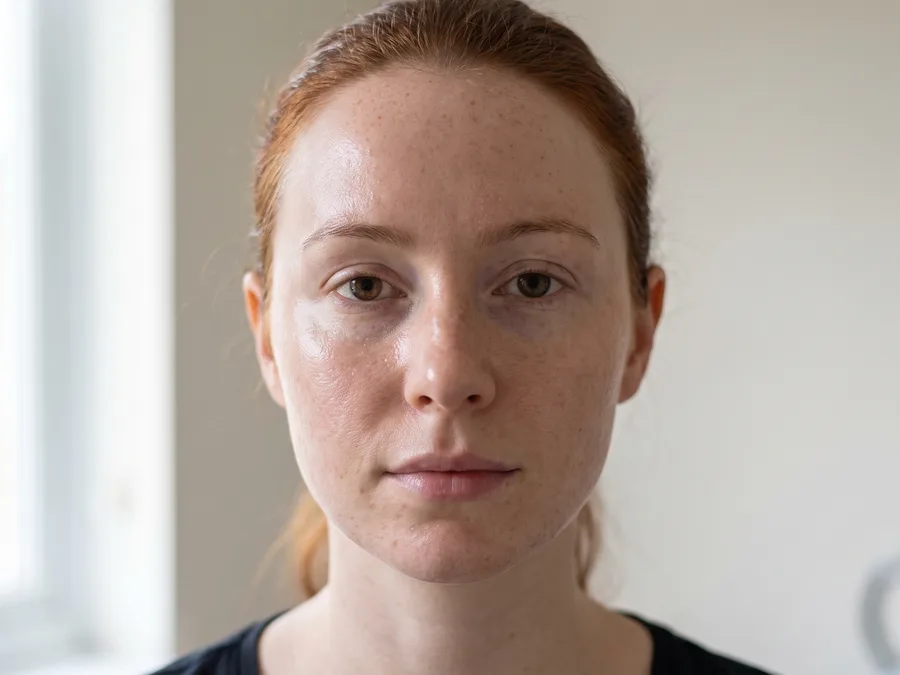
The whole face shines, pores are visible, breakouts come back. The paper picks up everywhere. It asks for light textures and regular cleansing, never harsh: stripped skin makes more oil to defend itself.
Is sensitive skin a skin type?
No, and the difference changes the answer. Sensitive skin reacts: it reddens, it stings, it pulls after a new product or a change in temperature.
That can happen to oily skin as easily as to dry skin. You can have combination and sensitive skin, or normal and sensitive skin, and those are two separate pieces of information that call for two separate answers.
Sensitivity is managed by what you take away rather than what you add: fewer products, no fragrance, no exfoliation while the skin is reacting.
When redness settles in instead of passing, it is no longer a reaction: it is a concern that can be treated, and changing creams will not settle it.
Dry or dehydrated: how do you tell the difference?
Dry skin lacks lipids. Dehydrated skin lacks water. Both feel tight, which is exactly why they get confused.
The test tells them apart: oily skin that still feels tight is dehydrated, not dry. The blotting paper picks up oil, and the skin is uncomfortable all the same.
The surface of the skin needs a certain amount of water to stay supple. The Xeroderma entry from the National Institutes of Health puts that level between 10 and 30 % in the stratum corneum, and notes that a damaged barrier lets water leave faster than it arrives.
The same entry names what damages it, and it reads like a Laval January: long, very hot showers, harsh soaps, cold weather, dry air and indoor heating. Skin that only feels tight in winter is far more often dehydrated than dry.
Dehydration is temporary and it can be corrected: fewer stripping cleansers, more water in the products, and a hydrating treatment in the room when your skin needs a hand. Dryness is a skin type, and it stays with you.
If you are still unsure
The home test answers the question in most cases. It reaches its limit when several things overlap, combination skin that reacts, redness that keeps coming back, breakouts that persist despite a sound routine.
That is where the skin analysis takes over. Our Visia device photographs your skin under several lights and shows what a mirror cannot: pores, pigment forming below the surface, deeper redness, the state of the texture. It is also what points to the facial that suits you.

The analysis is free and it belongs to the consultation. You leave with an answer and a plan, and you decide afterwards.