What exactly does the laser act on?
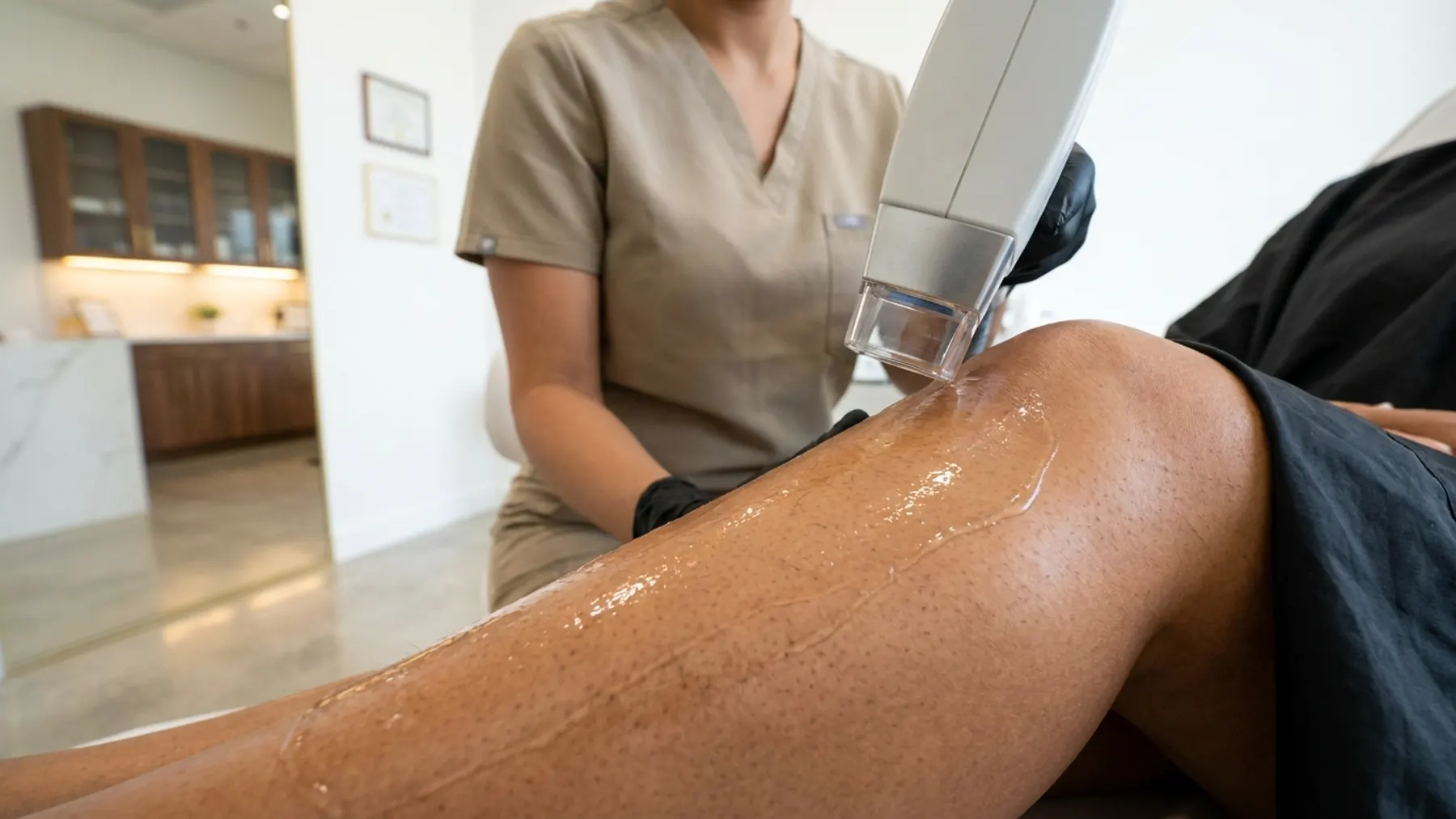
The laser targets the pigment, not the hair. Health Canada describes the device this way: it emits pulses of infrared radiation, and those pulses are absorbed by melanin, the pigment that gives hair its colour.
The hair you can see acts as a conductor. It picks the energy up at the surface and carries it down into the follicle, the small pocket where it is made.
That is why a hair shaved the day before works better than a long one: the shaft stays where it is useful, under the skin, instead of spending the pulse in open air.
Where the heat goes, and what it damages
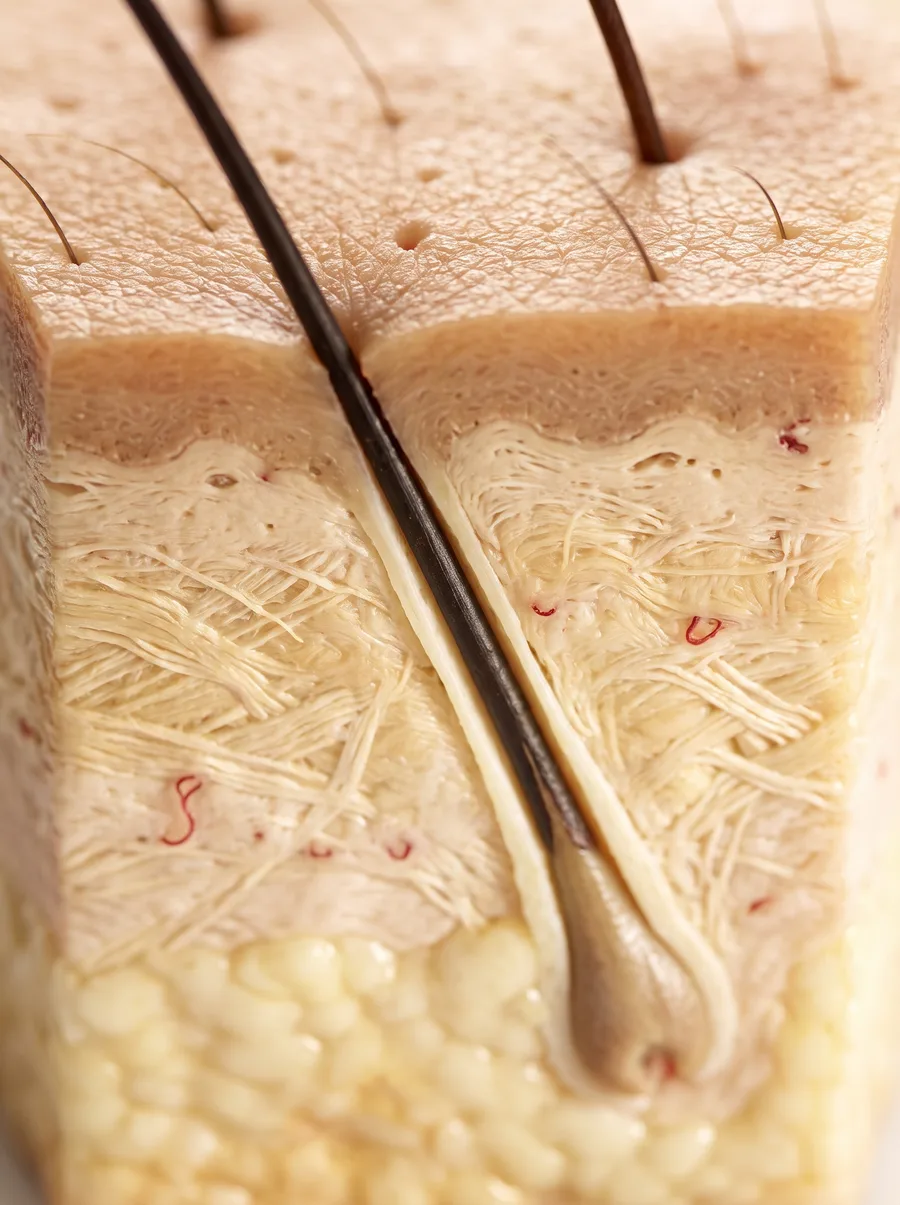
The energy melanin captures turns into heat and spreads to the structures around the follicle. Two of them matter, and they are what the treatment aims for.
That is what the StatPearls entry on laser hair removal, published by the National Institutes of Health, describes: the heat destroys the hair matrix and the stem cells of the bulge.
The hair
The visible shaft, full of melanin. It picks the energy up and carries it down. It is not the target, it is the path.
The matrix
The follicle's workshop. It builds the shaft, cell by cell. Damaged, it produces a finer, paler hair.
The bulge
The stem cell reserve, lower still. This is where the follicle restarts after a period of rest, and reaching it is what changes regrowth for the long run.
A follicle that takes that heat goes on to make a finer, paler, slower hair. Sometimes it makes nothing at all.
Why does only one phase of the hair count?
The matrix is only sensitive to the laser during the anagen phase, the active growing phase. StatPearls says it in one sentence, and it is the reason behind the whole calendar that follows.
Your hairs do not grow together. As you read this, the hairs in any one area are spread across three phases, set out in the hair anatomy entry from the same National Institutes of Health.
1
Anagen, the growing phase
The hair is attached to its root and getting longer. Its shaft is full of melanin, and the path down to the follicle is unbroken. This is the only phase where a pulse does real work.
2
Catagen, the transition
Production stops and the hair starts to separate from its root. The link comes apart, and the path is cut.
3
Telogen, the resting phase
The hair is still sitting in the skin, or has already fallen out, and the follicle sleeps until it starts again. A pulse sent now has nowhere to go.
On a single underarm, some hairs are asleep while others are growing. Today's session speaks to the second group.
Why your hair colour and your skin colour change everything
The laser finds its target by contrast. Your skin holds melanin too: the darker the hair against it, the sharper the target for the device.
That is what sets devices apart. The Elite iQ by Cynosure, the one we have here, carries two wavelengths: Alexandrite at 755 nm and Nd:YAG at 1064 nm. The second goes deeper and passes the melanin at the surface, which is what allows us to treat Fitzpatrick types 1 through 6, from very fair to very dark skin.
A cooling system protects the surface during every pulse. That is where the cold that comes with the snap of the pulse comes from.
The real limit sits elsewhere, in the colour of the hair. White, grey and very blonde hair holds too little melanin to carry the energy, whatever your skin tone. We point you to electrolysis instead, which works one hair at a time and does not depend on colour. The three hair removal methods are compared elsewhere on the site.
How many sessions does each area take?
We recommend a minimum of 10 sessions for a full series. Area by area, the count depends on your hormones, and here is what we see here, in Laval.
| Area | Sessions to plan for |
|---|---|
| Underarms, legs, bikini | 6 to 10, depending on your hormones |
| Face | 8 to 10, facial hair resists hormones more |
| Arms and back | 6 to 8 |
Underarms, legs, bikini
- Sessions to plan for
- 6 to 10, depending on your hormones
Face
- Sessions to plan for
- 8 to 10, facial hair resists hormones more
Arms and back
- Sessions to plan for
- 6 to 8
The minimum of ten covers the full series, every area together. One area on its own often finishes sooner, and that is what the table gives.
These are ranges, and the total varies from one person to the next on the same area. Two women booking their legs on the same day will not necessarily go through the same number of sessions.
Once the series is done, one maintenance session a year is usually enough. Hormonal changes wake follicles up over time, and that session picks them up.
This is reduction, not removal. The regrowth that comes back is finer and paler, and that is the result to expect. We give you a closer estimate once we have looked at your skin and your hair, at the free consultation.
Why do appointments spread further and further apart?
We give sleeping follicles the time they need to come back into their growing phase. The cycle sets the calendar, and it changes as the series goes on.
Early on, many hairs are growing and they come back quickly: sessions sit 4 to 6 weeks apart. Towards the end, the follicles that remain turn over more slowly, and it takes 6 to 8 weeks to catch them at the right moment.
A close appointment late in the series would bring back almost nothing: the laser would pass over an area whose resting hairs have not moved yet.
This is also why waxing, tweezing and epilators are set aside for the whole series. Those methods pull out the very root the laser needs to reach. A razor cuts the hair at the surface and leaves the follicle untouched, so shaving stays fine between appointments.
Why is winter the right season, in Laval?
The season decides nothing, the tan does. Skin recently exposed to the sun holds more melanin at the surface, which reduces the contrast with the hair and forces the settings down.
Here, the window where skin sits at its natural colour runs from autumn to spring. A series started then moves ahead without interruption, and it reaches summer with several sessions already behind it.
Summer itself is no obstacle, as long as you protect your skin and it is at its usual colour. What postpones a session is the week away, the weekend at the cottage and the self-tanner.